
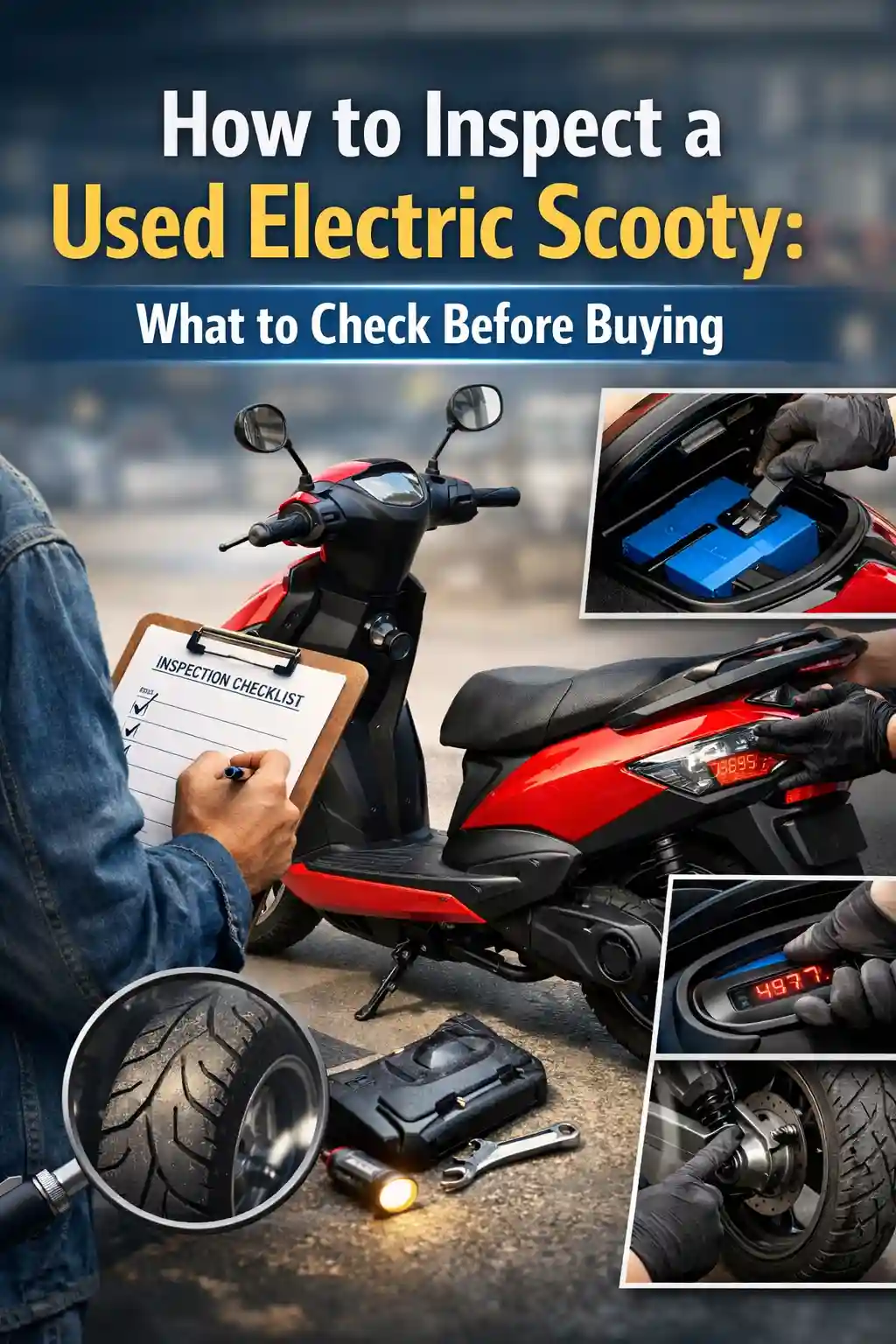
By a Certified Electric Scooty Specialist
Buying a used electric scooty can be one of the smartest financial decisions you’ll make. These vehicles offer affordable transportation with minimal running costs, and the pre-owned market is full of options at attractive prices. But unlike buying a new scooty where the manufacturer backs the quality, purchasing used means the responsibility falls entirely on you to ensure you’re getting a reliable vehicle.
A poorly inspected purchase can lead to expensive repairs, safety hazards, or a scooty that barely holds a charge. The battery alone can cost 40-60% of the scooty’s total value to replace. That’s why knowing how to properly inspect a used electric scooty isn’t just useful—it’s essential.
This guide walks you through every critical component to check, organized in the order you’d naturally examine a scooty. Whether you’re a first-time buyer or have experience with internal combustion scooties, these steps will help you make an informed decision.
Understanding What You’re Buying a Scooty
Before diving into the inspection, it helps to understand the basic components of an electric scooty and why they matter.
An electric scooty consists of four primary systems:
- The battery pack – The heart of the vehicle, typically lithium-ion or lead-acid
- The electric motor – Usually integrated into the rear wheel hub or center
- The controller – Manages power flow between battery and motor
- The chassis and drivetrain – Frame, wheels, brakes, and mechanical components
Each of these can fail or degrade, and the costs to repair or replace them vary significantly. A damaged frame might be fixable, but a failing battery often means the scooty isn’t worth buying at any price.
Pre-Inspection: Do Your Homework
Inspection begins before you even see the scooty. Gathering information beforehand helps you ask the right questions and spot inconsistencies.
Know the Model and Its Typical Issues
Research the specific make and model before meeting the seller. Every scooty has common weak points. For instance:
- Some Xiaomi Mi scooty models are known for loose stem clamps
- Certain Apollo scooties have throttle response issues after heavy use
- Some Ninebot models experience controller failures after 2-3 years
Search owner forums and reviews for recurring problems. Knowing what typically fails helps you focus your inspection on the right areas.
Ask About the Scooty’s History
When communicating with the seller, ask specific questions:
- How long have they owned it?
- What is the typical riding terrain (flat roads, hills, rough surfaces)?
- Has it ever been involved in a crash or dropped?
- Has the battery ever been replaced?
- Are there maintenance records available?
- Why are they selling?
Watch for vague answers or reluctance to provide details. An honest seller will have no problem answering these questions.
Visual Exterior Inspection
Start with a thorough visual examination. Many problems leave visible clues.
Frame and Bodywork
Stand back and look at the scooty from multiple angles. You’re checking for:
Alignment issues – Both handlebars should be parallel to the front wheel. The front fork should appear straight. Misalignment often indicates past crash damage or a bent stem.
Cracks or fractures – Examine the folding mechanism, stem area, and deck connections. Run your fingers along seams and joints. Hairline fractures in the frame are serious safety concerns that often worsen over time.
Corrosion – Check metal components, especially around the base of the stem, battery compartment, and wheel axle areas. Surface rust is cosmetic; deep corrosion compromises structural integrity.
Loose or missing screws – Every visible fastener should be tight. Missing screws or stripped threads often indicate the scooty has been disassembled multiple times or poorly maintained.
Stem and Handlebars
The stem connects your handlebars to the front wheel—failure here is catastrophic.
- Check the folding mechanism – If the scooty folds, test it several times. It should lock firmly into place with no wobble or play. Excessive movement suggests worn clamps or damaged latches.
- Test handlebar rotation – With the scooty stationary, try turning the handlebars fully left and right. They should move smoothly without binding or catching.
- Check throttle and grip condition – The throttle should click smoothly from closed to open. Grips should be firmly attached with no tears that could affect control.
Tires and Wheels
Tires reveal a lot about how the scooty was maintained and ridden.
Tire tread depth – Most electric scooty tires are solid or pneumatic. For pneumatic (air-filled), check tread like you would on a car—at least 2mm is ideal. Worn tires compromise grip, especially in wet conditions.
Sidewall condition – Look for cracks, bulges, or cuts on the sidewalls. These weaken the tire and can cause blowouts.
Wheel trueness – Spin each wheel. It should spin freely without wobbling or rubbing against the brake pads. Visible wobble indicates bent rims or loose axle bearings.
Bearing condition – Lift each wheel off the ground and spin it by hand. You should hear a smooth whir with no grinding, clicking, or roughness. Bad bearings feel rough and sound noisy.
Brakes
Brakes on electric scooties differ from traditional bikes. Common types include:
- Disc brakes – Most common on higher-powered scooties
- Drum brakes – Enclosed, lower maintenance
- Regenerative braking – Uses motor resistance, supplements physical brakes
Check disc brake pads for wear—if they’re thinner than 2mm, they’ll need replacement soon. Drum brakes are harder to inspect visually, but you can test them functionally during the test ride. Ensure brake levers feel firm with no sponginess, which indicates air in hydraulic lines.
Battery Inspection: The Most Critical Check
The battery is the most expensive component and the one most likely to cause problems in a used electric scooty. This section deserves extra attention.
Understanding Battery Degradation
All batteries lose capacity over time. A lithium-ion battery typically retains 70-80% of original capacity after 500-700 charge cycles—which translates to roughly 2-4 years of regular use. Lead-acid batteries degrade faster, often needing replacement after 1-2 years.
What this means: A scooty advertised with a 40 km range might actually only manage 25-30 km if the battery is heavily degraded.
Visual Battery Inspection
Start with external checks:
Physical damage – Look for swelling, dents, or cracks on the battery casing. Swelling is particularly dangerous and indicates internal cell failure. Walk away from any scooty showing this.
Water damage indicators – Check for water stains, corrosion on terminals, or mineral deposits. Electric scooties and water don’t mix well.
Connector condition – The charging port and battery connector should be clean, undamaged, and free of debris. Bent pins or corrosion cause charging problems.
Testing Battery Performance
This is where you separate a good buy from a money pit.
Request a full charge test – Ask to see the scooty when the battery is fully charged. A seller who shows you a scooty at 20% charge may be hiding poor range.
Check the displayed percentage – After charging, the display should show 100% or close to it. If it jumps to 100% immediately then drops rapidly, the battery management system may be malfunctioning or the battery is failing.
Test the actual range – This requires a test ride. Pay attention to how quickly the percentage drops. A healthy battery should show minimal percentage drop during the first few kilometers. If it plummets from 100% to 80% within the first couple kilometers, the battery is significantly degraded.
If possible, use a battery diagnostic tool – Some owners have apps or tools that read battery health data. This is more common on premium scooties with Bluetooth connectivity.
Scooty Charging Test
Plug in the charger and observe:
- The indicator light should change to show charging
- The battery percentage should increase on the display
- After 30 minutes, check if the charger feels excessively hot
- The charger should have a working fan (if equipped)
A battery that won’t charge, charges very slowly, or gets dangerously hot has problems that will likely require expensive battery replacement.
Motor and Electrical Systems
Motor Inspection
The motor is generally durable, but there are things to check.
Listen for unusual sounds – With the scooty elevated (or during the test ride), listen for grinding, clicking, or whining noises from the motor area. These indicate bearing wear or internal damage.
Check for free movement – The rear wheel should spin freely when the scooty is off. If there’s resistance or the motor feels “grindy,” the motor may be failing.
Look for burns or melted plastic – Scorch marks around the motor housing suggest overheating, which can occur from sustained hill climbing, overloading, or controller problems.
Electrical System Check
Turn the scooty on and verify:
Display functionality – All segments should light up. Check that speed, battery percentage, and distance displays work correctly. Flickering displays often indicate wiring problems.
Lights work – Test headlights, taillights, and brake lights. Non-functional lights aren’t just illegal—they may indicate broader electrical issues.
Throttle response – The motor should engage smoothly when you twist the throttle. Look for:
- Delayed response
- Intermittent engagement
- Jerky power delivery
- Motor cutting out at certain throttle positions
These symptoms suggest throttle, controller, or motor problems.
Controller Diagnostics
The controller manages power flow and is difficult to inspect directly. However, symptoms of controller problems include:
- Scooty cutting out unexpectedly
- Inconsistent power delivery
- Battery draining faster than normal
- Error codes on the display
If you notice any of these during your test ride, walk away or factor in controller replacement costs (typically Rs 8,000-Rs 20,000 depending on scooty model).
The Test Ride: Your Most Important Inspection
No inspection is complete without actually riding the scooty. This reveals problems that aren’t visible.
Pre-Ride Checks
Before you start:
- Ensure you’re in a safe, legal area to test ride
- Wear a helmet—even for a short test
- Verify brakes work before you start moving
- Adjust the handlebar height if adjustable
What to Observe While Riding
Acceleration – Power should come on smoothly and progressively. Jerky acceleration indicates throttle or controller problems.
Top speed – The scooty should reach its expected top speed (check manufacturer specs). Significantly lower speeds suggest motor or battery problems.
Handling – The scooty should feel stable and responsive. Wobbling at speed is dangerous and indicates alignment or bearing problems.
Braking – Test brakes at various speeds. They should bring you to a controlled stop without pulling to one side or squealing excessively.
Range test – If possible, ride until the battery drops to 50% to see how it performs under real conditions. Pay attention to whether the speed drops noticeably as battery percentage decreases—this indicates battery degradation.
Listen and Feel
Throughout the ride, note any:
- Unusual vibrations
- Grinding or clicking sounds
- Squeaking from the stem or wheels
- Feeling of looseness in the stem or deck
These sensations often precede mechanical failures.
Documentation and Legal Verification
A technically sound scooty isn’t a good buy if the paperwork is wrong.
Ownership Documents
Verify:
- The seller actually owns the scooty (title or purchase receipt)
- Their identity matches the documents
- There are no outstanding loans or liens on the vehicle
Registration and Insurance
Depending on your region:
- Registration certificate – Confirm the scooty’s registration is valid and transfers to you
- Insurance – At minimum, third-party insurance should be active or transferable
- Service history – While not always available, records of regular servicing indicate better care
Model Year Verification
Check that the scooty’s model year matches what the seller claims. This affects:
- Remaining battery life (older = more degradation)
- Availability of replacement parts
- Compatibility with accessories
Red Flags That Should Make You Walk Away
Some issues indicate problems too severe to justify purchase, regardless of price.
- Frame cracks or welds – Structural damage cannot be safely repaired
- Battery swelling – Fire risk and indicator of cell failure
- Motor noise or resistance – Imminent motor failure
- Inconsistent electrical behavior – Multiple electrical gremlins suggest systemic issues
- Seller can’t demonstrate it works – If they make excuses for why you can’t test ride or charge it, there’s likely something wrong
- No documentation – Without ownership proof, you may have legal issues
- Significantly modified scooties – Custom wiring or non-professional modifications often cause problems
- Immediately after a crash – Even if repairs look good, hidden damage may remain
Negotiating Based on Findings
Once you’ve completed your inspection, you have ammunition for negotiation.
Common Deductions from Asking Price
Use these estimates if issues are found:
- Worn tires – Rs 1,500-Rs 4,000 for replacement
- Bad brakes – Rs 2,000-Rs 5,000 for pad replacement or adjustment
- Battery degradation – Difficult to negotiate, but a 20% range reduction typically justifies 15-25% off asking price
- Bearing replacement – Rs 1,500-Rs 3,000
- Stem or folding mechanism play – Rs 2,000-Rs 5,000 if repairable
- Cosmetic damage – Negotiable but primarily aesthetic
The Strategy
Start by acknowledging what you liked about the scooty, then present your findings objectively. Sellers respond better to factual, matter-of-fact observations than accusations. Frame it as: “I’d like to buy this scooty, but I found some issues that need addressing. Based on [specific finding], I’m offering Rs X.”
Be prepared to walk away. If the seller won’t negotiate reasonably on significant issues, there are other scooties available.
Final Inspection Checklist
Print or save this checklist for your next viewing:
| Category | Check Item | Status |
| Frame | No cracks, bends, or corrosion | ☐ |
| Stem | No play when folded and locked | ☐ |
| Handlebars | Straight, smooth rotation, grips secure | ☐ |
| Tires | Adequate tread, no cracks or damage | ☐ |
| Wheels | Spin freely, no wobble | ☐ |
| Brakes | Pads have material, levers firm | ☐ |
| Battery | No swelling, charges properly | ☐ |
| Battery Health | Holds charge, range adequate | ☐ |
| Motor | No noise, smooth operation | ☐ |
| Display | All functions working | ☐ |
| Lights | Headlight, taillight, brake light work | ☐ |
| Throttle | Smooth response, no stuttering | ☐ |
| Test Ride | Handles well, brakes work, reaches speed | ☐ |
| Documents | Ownership verified, registration valid | ☐ |
Conclusion
Buying a used electric scooty doesn’t have to be risky. By systematically inspecting each component—starting with the frame and working through to the battery and electrical systems—you can identify problems before committing your money.
The battery deserves special attention because it determines both your daily range and your long-term costs. A scooty with a degraded battery that needs replacement in a year may cost more overall than buying one in better condition at a higher price.
Take your time during the inspection. Rushing leads to missed problems that become expensive surprises later. If something feels off, trust your instincts. There are always other scooties available, and patience typically leads to a better purchase.
A thorough inspection transforms buying used from a gamble into a calculated decision—one where you know exactly what you’re getting and at what price. That’s how you find real value in the pre-owned electric scooty market.