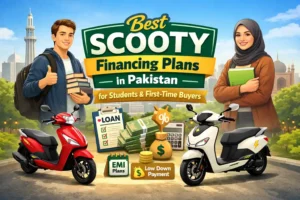
Whether you’re a student navigating city traffic, a young professional commuting for work, or a first-time buyer dreaming of your own ride, owning a scooty in Pakistan is a smart choice. Scooties are fuel-efficient, easy to park, and perfect for urban travel.
But here’s the big question:
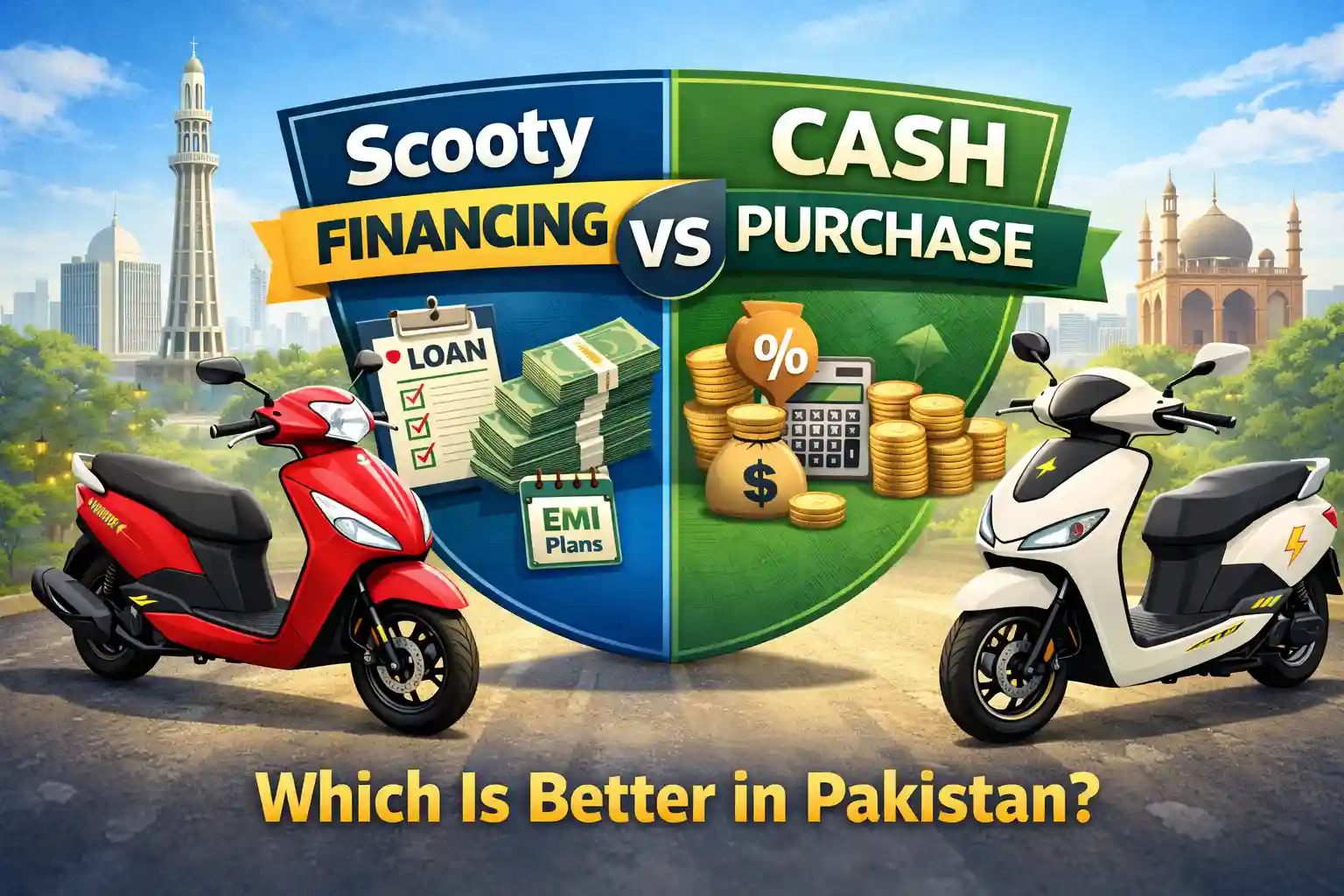
Scooty Financing vs Cash Purchase – Which Is Better?
Both options are widely used across Pakistan, but each comes with its own advantages and limitations. In this complete comparison, we’ll break down:
- Total cost of ownership
- Monthly payments vs one-time payment
- Pros and cons of both paths
- Real scenarios for different buyer types
- A smart recommendation based on financial goals
Let’s dive in.
What Is Scooty Financing?
Scooty financing allows you to own your scooty now and pay later in monthly installments. Instead of paying the full price upfront, you make a down payment (usually 10–30%) and pay the rest over time.
Common Financing Sources in Pakistan
- Banks: Formal, documented financing with structured EMIs.
- Leasing Companies: Often Islamic finance options available.
- Dealer Installments: Quick approvals, sometimes with flexible terms.
- Interest-Free Plans: Occasionally available for short durations.
Each source has a different cost structure and eligibility requirements, which we’ll unpack later.
What Does Cash Purchase Mean?
A cash purchase means you pay the full price of the scooty upfront—either from your savings or by borrowing from family. No monthly bills, no financing charges, and no ongoing commitments.
Key Differences: Financing vs Cash
Let’s start with a snapshot comparison:
| Aspect | Scooty Financing | Cash Purchase |
| Upfront Cost | Low | High |
| Monthly Commitment | Yes | No |
| Total Cost (with interest) | Higher | Lower |
| Ownership Timing | Immediate | Immediate |
| Opportunity Cost | Low | High |
| Credit History Impact | Can improve | No impact |
| Risk of Default | Yes | No |
Financial Comparison: Real Numbers
Here’s a simple example to make this relatable.
Assumptions
- Scooty price: PKR 150,000
- Down payment (financing): 20% = PKR 30,000
- Financed amount: PKR 120,000
- Tenure: 24 months
- Average markup: 12% annually (varies by bank/dealer)
Cash Purchase Cost
- Total paid: PKR 150,000
Financing Cost
Calculating EMIs (simplified):
Using standard EMI formulas, monthly EMIs for PKR 120,000 at ~12% markup might be around:
📌 PKR ~5,600 per month
Total paid over 24 months:
- 24 × 5,600 = PKR 134,400
- Down payment = PKR 30,000
- Total: ~PKR 164,400
📊 Difference: Financing costs roughly PKR 14,400 more than cash.
Pros & Cons Breakdown
🔹 Scooty Financing: Pros
✅ Immediate ownership: You start riding right away.
✅ Low upfront cost: Great if you don’t have full savings.
✅ Better cash flow: Can manage other expenses.
✅ Builds credit history: If you pay on time.
🔹 Scooty Financing: Cons
❌ Higher total cost: Due to markup/interest.
❌ Monthly commitment: Reduces disposable income.
❌ Penalties for late payments: Can get expensive.
❌ Risk of repossession: If payments lapse.
🔹 Cash Purchase: Pros
✅ Lowest total cost: No interest or markup.
✅ No monthly burden: Full peace of mind.
✅ No financing risk: You own it outright.
🔹 Cash Purchase: Cons
❌ Large initial expense: Hard for many buyers.
❌ Opportunity cost: Money could be invested elsewhere.
❌ Liquidity reduction: Less cash for emergencies.
Who Should Choose Scooty Financing?
Scooty financing makes sense if:
👍 1. You Don’t Have Full Cash
If saving PKR 150,000 (or more) is challenging, financing breaks the cost into manageable EMIs.
👉 Very common for students, young professionals, and new riders.
👍 2. You Expect Income Growth
If you’re confident your income will increase over the next 12–24 months, financing helps you get the scooty now while paying later.
👍 3. You Want Better Cash Flow
Keeping savings while paying monthly could be useful for emergencies, education, or work.
⚠️ 4. You Can Stick to the Payment Plan
If you’re organized and can pay EMIs on time, financing builds discipline and even credit history.
Who Should Pay in Cash?
Cash purchase is usually best if:
💡 1. You Have Full Savings Ready
No need to borrow, no interest—simple!
💡 2. You Want the Lowest Cost
Cash always wins total cost compared to financing.
💡 3. You Don’t Like Monthly Bills
No credit checks, no penalties, no due dates.
Hidden Costs & Things to Watch Out For
Whether you finance or pay cash, there are extra costs many buyers overlook:
📌 Registration & License Fees
Every vehicle must be registered—usually a few thousand rupees.
📌 Insurance
Mandatory in many cities, and optional based on risk tolerance.
📌 Processing Charges
Some financing plans add processing fees.
📌 Late Payment Penalties
If financing—missing EMIs adds cost.
📌 Delivery Charges & Accessories
Helmets, locks, covers, and carrier racks add to the final spend.
Real Buyer Scenarios
Scenario 1: Student With Part-Time Income
- Not enough cash saved
- Stable part-time stipend
- Wants independence
Best choice: Scooty financing via dealer or low-down-payment plan.
Scenario 2: Young Professional With Savings
- Stable monthly income
- Full cash available
- Wants to minimize total cost
Best choice: Cash purchase (pay upfront & save on interest).
Scenario 3: Unpredictable Income (Freelancer)
- Earnings vary month to month
- Cash savings limited
- Wants flexibility
Best choice: Short-tenure financing with low EMI or save more & buy cash later.
Financing Tips Before You Sign
To make the smartest decision:
✔ Compare multiple dealers
Prices vary widely—even for the same scooty.
✔ Understand markup rates
Different banks/dealers quote differently.
✔ Ask for full cost breakdown
Monthly EMI, total payable, processing charges, penalties.
✔ Avoid long tenures
Shorter term usually reduces markup totals.
✔ Read the contract carefully
Don’t agree without documented terms.
Cash Tips for Safer Purchase
💡 Negotiate upfront
If paying cash, negotiate the price—it’s common.
💡 Ask for freebies
Extras like helmets or free registration sometimes come with cash deals.
💡 Confirm warranty
Ensure warranty and post-sale support.
Final Verdict: Which Is Better?
The truth is: There’s no one-size-fits-all answer.
✅ Cash purchase wins in total cost and simplicity.
✅ Financing wins in accessibility and cash flow.
Here’s a simple rule of thumb:
👉 If you can pay without hurting your financial stability — go cash.
👉 If monthly EMIs fit your budget better — choose financing wisely.
The smarter choice always depends on your personal situation, not a general rule.
Also Read: Electric Scooty Financing Options in Pakistan – Banks, Leasing & Installment Plans Compared
FAQs
1. Does financing cost more than buying scooty in cash?
Yes — financing usually costs more because of markup/interest and processing charges.
2. Can students get scooty financing in Pakistan?
Yes! Many dealers offer student-friendly installment plans. Banks may require a guarantor.
3. Is it harder to sell a financed scooty?
Not really — but loan obligations must be settled before transferring ownership.
4. What is the ideal EMI tenure for scooty financing?
Usually 12–24 months — shorter tenures save on markup but increase monthly EMIs.
5. Are electric scooties easier to finance?
Many leasing companies and dealers are promoting electric scooty financing due to lower maintenance costs.